
What Is Magnesium Glycinate Dosage?
Magnesium glycinate dosage refers to the amount of magnesium glycinate you take per serving, but the most important number is elemental magnesium.
Magnesium Glycinate vs Elemental Magnesium
This is the first thing to understand.
Magnesium glycinate is a compound made by binding magnesium to glycine. Elemental magnesium is the actual magnesium delivered by that compound. When people ask, "How much magnesium glycinate should I take?" they usually need to know how much elemental magnesium is in the serving.
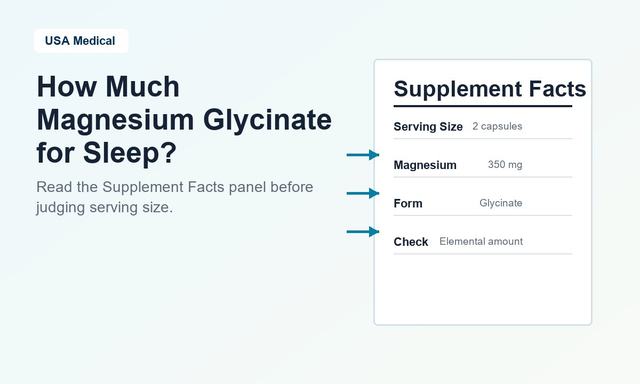
For example, a label may mention magnesium glycinate, magnesium bisglycinate, or chelated magnesium glycinate. That does not automatically mean the entire number is pure magnesium. The Supplement Facts panel should show the amount of magnesium per serving.
Look for phrases like:
- Magnesium
- Magnesium as magnesium glycinate
- Elemental magnesium
- Amount per serving
- % Daily Value
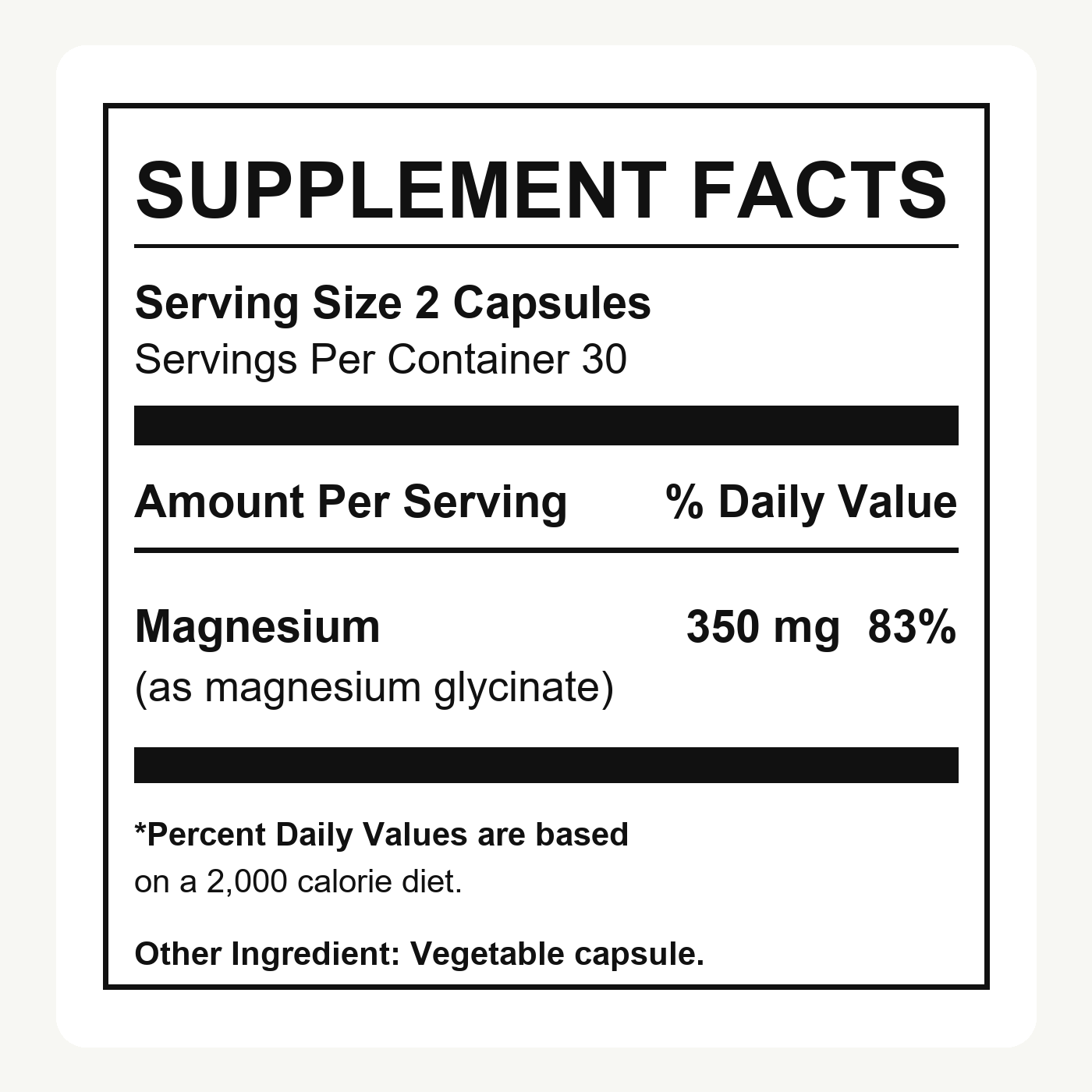
The "Magnesium" line in the Supplement Facts panel is usually the number you should focus on when comparing dosage.
When checking magnesium glycinate dosage, look for elemental magnesium, not just the total compound name.
Why the Label Matters Most
The product label is the best starting point for dosage.
A good supplement label tells you the serving size, servings per container, amount of magnesium per serving, suggested use, and warnings. This matters because different products can have different strengths. One brand may suggest one capsule. Another may suggest two. A powder may use scoops. A gummy may use multiple pieces.
Before taking magnesium glycinate, check:
- Serving size
- Magnesium per serving
- Suggested use
- Warnings
- Other ingredients
- Servings per container
Do not assume all magnesium glycinate supplements are dosed the same way.
The right dosage starts with your specific product, not a generic number online.
Why More Is Not Always Better
Magnesium is essential, but taking more does not automatically mean better results.
High amounts of supplemental magnesium can cause digestive side effects such as loose stool, diarrhea, nausea, and stomach cramping. Very high intakes can be dangerous, especially for people with kidney problems or certain medical conditions.
This is especially important for sleep. Some people assume that if a little magnesium helps them relax, more will help them sleep even better. That is not a safe assumption. The goal is to find a consistent, reasonable serving that supports your routine without causing side effects.
The best magnesium glycinate dosage is the amount that fits the label, your needs, and your tolerance without overdoing it.
Magnesium glycinate dosage is not just about taking a capsule. It is about understanding the actual magnesium amount and using it responsibly.
How Much Magnesium Do Adults Need?
Magnesium needs depend on age, sex, diet, health status, and life stage.
General Daily Magnesium Needs
Adults typically need a few hundred milligrams of total magnesium per day from food, beverages, and supplements combined.
General daily magnesium needs are often listed around:
- Adult men: about 400 to 420 mg per day
- Adult women: about 310 to 320 mg per day
- Pregnancy: needs may be higher depending on age
- Breastfeeding: needs vary by age
These numbers refer to total magnesium intake, not necessarily supplement dosage. That means magnesium from food counts too. Nuts, seeds, legumes, whole grains, leafy greens, fortified foods, milk, and yogurt can all contribute magnesium.
Your daily magnesium need includes magnesium from both food and supplements.
Supplemental Magnesium Is Different From Food Magnesium
Magnesium from food and magnesium from supplements are treated differently when discussing upper limits.
Food magnesium is generally not a concern for healthy people because the body can eliminate excess amounts through urine. Supplemental magnesium is different. High doses from supplements or medications are more likely to cause side effects.
This is why you should not use daily magnesium needs as permission to take that full amount from supplements. If an adult man needs around 400 to 420 mg of magnesium per day, that does not automatically mean he should take 400 to 420 mg from magnesium glycinate.
The recommended daily magnesium intake is not the same as the recommended supplement dose.
The Adult Upper Limit for Supplemental Magnesium
For adults, the tolerable upper intake level for magnesium from dietary supplements and medications is commonly listed as 350 mg per day unless a healthcare professional recommends otherwise.
This upper limit does not include magnesium naturally found in food. It applies to supplemental magnesium and magnesium-containing medications.
This distinction is important. If your supplement provides 200 mg of elemental magnesium and your multivitamin provides another 100 mg, your total supplemental magnesium is already 300 mg. If you also take an electrolyte powder with magnesium, you may be closer to the upper limit than you realize.
When using magnesium glycinate, count all supplemental magnesium sources together.
Adults need magnesium daily, but supplement dosage should be approached more carefully than food intake.
How to Read a Magnesium Glycinate Label
The label tells you how much magnesium you are actually taking.
Step 1: Find the Supplement Facts Panel
Start with the Supplement Facts panel, not the marketing text on the front.
The front of the bottle may say "high potency," "sleep support," "chelated," "gentle," or "magnesium glycinate." Those phrases may describe the product, but they do not tell you your exact serving.
The Supplement Facts panel should show:
- Serving size
- Servings per container
- Amount of magnesium per serving
- % Daily Value
- Source or form of magnesium
- Other ingredients
This is where dosage decisions should begin.
The Supplement Facts panel is more important than the front label.
Step 2: Check Serving Size
Serving size tells you how many capsules, tablets, gummies, or scoops equal one serving.
This matters because one serving may be more than one capsule. If the serving size is two capsules and you only take one, you are taking half the listed magnesium amount. If the serving size is three gummies and you take all three, you are taking the full listed amount.
Examples:
| Label Serving Size | What It Means |
|---|---|
| 1 capsule | One capsule provides the listed magnesium |
| 2 capsules | Two capsules provide the listed magnesium |
| 1 scoop | One scoop provides the listed magnesium |
| 3 gummies | Three gummies provide the listed magnesium |
Do not assume one capsule equals one full serving.
Serving size tells you how much product equals the listed magnesium amount.
Step 3: Find the Magnesium Amount
Next, find the magnesium amount per serving.
This may be written as:
- Magnesium 100 mg
- Magnesium 200 mg
- Magnesium 350 mg
- Magnesium as magnesium glycinate
- Magnesium from magnesium bisglycinate chelate
The key number is the magnesium amount per serving. If the label says "Magnesium 200 mg," then one serving provides 200 mg of magnesium, even if the compound amount is larger.
The magnesium amount per serving is the dosage number that matters most.
Step 4: Check Other Sources of Magnesium
Before deciding your magnesium glycinate dosage, check your other supplements.
Magnesium can appear in:
- Multivitamins
- Electrolyte powders
- Sleep blends
- Greens powders
- Protein powders
- Antacids
- Laxatives
- Other mineral supplements
If you take more than one product with magnesium, add them together.
Example:
| Product | Supplemental Magnesium |
|---|---|
| Magnesium glycinate | 200 mg |
| Multivitamin | 50 mg |
| Electrolyte powder | 75 mg |
| Total supplemental magnesium | 325 mg |
That total matters more than any single bottle.
Your real dosage is the total magnesium you get from all supplement and medication sources.
Reading the label carefully helps you avoid both underdosing and accidentally taking too much.
Magnesium Glycinate Dosage for Sleep
Many people take magnesium glycinate at night, but the dose should still be label based.
Start With the Suggested Use
If you are taking magnesium glycinate for sleep, begin with the suggested use on the label.
Do not start by doubling the serving because you want stronger sleep results. Magnesium glycinate is not a sleeping pill. It may support relaxation and a healthy bedtime routine, but more does not automatically mean better sleep.
A practical nighttime approach is:
- Read the label.
- Check elemental magnesium.
- Take the suggested serving.
- Use it consistently.
- Watch for digestive side effects.
- Adjust only if appropriate.
If the label allows flexible serving sizes, some people prefer starting with the lower end to test tolerance.
For sleep, magnesium glycinate dosage should be steady and label based, not aggressive.
Take It at a Consistent Time
Timing can matter as much as dosage.
Many people take magnesium glycinate in the evening, often during their wind down routine. That might be after dinner, after brushing teeth, or 30 to 60 minutes before bed.
The exact timing is less important than consistency. If taking it after dinner helps you remember, use dinner. If brushing your teeth is the stronger habit, use that. The best dosage will not help if you forget it half the time.
A consistent evening routine can make magnesium glycinate more useful than changing the dose constantly.
Pair It With Better Sleep Habits
Magnesium glycinate works best when it is part of a real sleep routine.
A simple sleep routine might include:
- Take magnesium glycinate.
- Dim the lights.
- Stop work for the night.
- Reduce screen use.
- Keep the room cool and dark.
- Go to bed at a consistent time.
If caffeine, late screens, stress, alcohol, or irregular sleep timing are the real issues, increasing magnesium dosage is unlikely to fix everything.
For sleep, magnesium glycinate should support the routine, not replace it.
Magnesium glycinate dosage for sleep should focus on consistency, tolerance, and overall sleep habits.
How Much Magnesium Glycinate Should You Take Daily?
The best daily magnesium glycinate amount depends on your diet, label, health status, and total supplement intake.
A Simple Dosage Decision Process
Use this process before choosing a daily dosage:
- Read your product label.
- Find elemental magnesium per serving.
- Check how many capsules or scoops make one serving.
- Add other supplemental magnesium sources.
- Compare your total with the adult supplemental upper limit.
- Consider your diet and reason for taking magnesium.
- Ask a healthcare professional if you take medications or have health conditions.
This process is safer than copying a dose from someone online.
The right magnesium glycinate dosage is personal, but the decision process should be clear.
When a Lower Serving May Make Sense
A lower serving may make sense if you are new to magnesium or sensitive to supplements.
You may want to be more cautious if:
- You have never taken magnesium before.
- You have a sensitive stomach.
- You already take a multivitamin.
- You use electrolyte powders.
- You are taking magnesium near bedtime.
- You are not sure how you will tolerate it.
If the product directions allow flexibility, starting lower can help you understand how your body responds.
A lower starting serving can be useful when tolerance is uncertain.
When to Ask a Healthcare Professional
Some people should not guess their magnesium dosage.
Ask a doctor, pharmacist, or qualified healthcare professional before taking magnesium glycinate if you:
- Have kidney disease
- Take prescription medications
- Are pregnant or breastfeeding
- Have heart rhythm problems
- Use magnesium-containing antacids or laxatives
- Have chronic digestive issues
- Are taking antibiotics or osteoporosis medications
- Have been told your magnesium levels are abnormal
Magnesium can interact with medications and may not be appropriate for everyone.
If your health situation is more complex, magnesium dosage should be guided by a professional.
The safest daily magnesium glycinate dosage is the one that fits your label, total magnesium intake, and personal health situation.
Can You Take Too Much Magnesium Glycinate?
Yes, it is possible to take too much magnesium from supplements.
Common Signs of Too Much Supplemental Magnesium
The most common early signs of too much supplemental magnesium are digestive.
Possible symptoms include:
- Diarrhea
- Loose stool
- Nausea
- Stomach cramping
- Abdominal discomfort
Magnesium glycinate is often considered gentle, but it can still cause problems if the serving is too high or if you combine it with other magnesium products.
Digestive discomfort is often the first sign that your magnesium serving may be too high.
Serious Magnesium Toxicity Is Rare but Possible
Very high magnesium intake can become dangerous.
Serious symptoms can include low blood pressure, vomiting, facial flushing, muscle weakness, difficulty breathing, irregular heartbeat, and in extreme cases, cardiac arrest. This is more likely with very high doses from supplements or medications and in people whose kidneys cannot remove magnesium properly.
This is why kidney disease is such an important warning. Healthy kidneys help remove excess magnesium, but impaired kidney function can increase risk.
Serious magnesium toxicity is uncommon, but the risk is higher with excessive intake or impaired kidney function.
What to Do if the Dose Feels Too Strong
If magnesium glycinate causes side effects, do not keep forcing the same serving.
Consider:
- Stop taking it temporarily.
- Review the label.
- Check all other magnesium sources.
- Reduce the serving if the label allows.
- Take it with food if appropriate.
- Ask a healthcare professional if symptoms continue.
Do not ignore persistent diarrhea, irregular heartbeat, weakness, breathing problems, or severe symptoms.
If your magnesium dosage causes side effects, treat that as a signal to reassess.
Magnesium glycinate is generally well tolerated, but more is not always safer or more effective.
Best Time to Take Magnesium Glycinate
The best time depends on why you take it and when you will remember.
Magnesium Glycinate at Night
Many people take magnesium glycinate at night because it fits a calm evening routine.
A nighttime routine may look like:
- Take magnesium glycinate after dinner.
- Drink water.
- Dim lights.
- Reduce screens.
- Read or relax.
- Go to bed consistently.
This is especially useful for people taking magnesium glycinate for sleep or relaxation support. The key is to take it early enough that you do not forget.
Nighttime is a practical choice when magnesium glycinate is part of your wind down routine.
Magnesium Glycinate in the Morning
Some people prefer morning.
Morning may be better if you forget supplements at night, if your evenings are unpredictable, or if your label suggests taking it with food and breakfast is your most consistent meal.
A morning routine may look like:
- Take magnesium glycinate with breakfast.
- Drink water.
- Mark it complete.
- Continue the day.
The best time is the time you can repeat.
Morning can work well if it helps you stay consistent.
Split Servings
Some people split magnesium into two smaller servings if the product label allows it.
This can be useful if one full serving feels heavy or if you want to reduce digestive discomfort. However, splitting servings can also make the routine more complicated. If you are already inconsistent, one simple daily time may be better.
Split servings can help some people, but they only work if the routine stays easy to follow.
The best time to take magnesium glycinate is the time that fits your routine and helps you take it consistently.
Common Magnesium Glycinate Dosage Mistakes
Most dosage mistakes come from misunderstanding labels or taking too many magnesium products.
Mistake 1: Confusing Compound Amount With Elemental Magnesium
This is the biggest label mistake.
A magnesium glycinate compound amount may look large, but elemental magnesium is the key number. Always check the Supplement Facts panel.
The elemental magnesium amount is the dosage number to focus on.
Mistake 2: Ignoring the Serving Size
If the serving size is two capsules, one capsule is not the full serving.
Always check how many capsules, tablets, gummies, or scoops make one serving before deciding how much to take.
Serving size tells you how much product equals the listed dose.
Mistake 3: Combining Too Many Magnesium Products
Magnesium can appear in products you may not think about.
Multivitamins, sleep blends, electrolyte drinks, antacids, and laxatives can all contain magnesium. Add them together before deciding your daily intake.
Total supplemental magnesium matters more than one product by itself.
Mistake 4: Taking More for Faster Results
Taking more magnesium glycinate does not guarantee better sleep, better relaxation, or better results.
It may only increase the risk of digestive side effects.
More magnesium is not automatically better.
Mistake 5: Not Asking About Medication Interactions
Magnesium can interfere with certain medications or be affected by them.
This includes some antibiotics, osteoporosis medications, diuretics, and acid reflux medications. A pharmacist or healthcare professional can help you separate timing or decide whether magnesium is appropriate.
Medication interactions should be checked before making magnesium glycinate a daily habit.
Most magnesium dosage mistakes can be avoided by reading the label, counting total intake, and staying cautious.
Conclusion: The Best Magnesium Glycinate Dosage Is Label Based and Personal
The right magnesium glycinate dosage depends on the product, the amount of elemental magnesium, your total magnesium intake, your diet, and your health situation. Start with the Supplement Facts panel, follow the suggested use, and remember that the adult upper limit for supplemental magnesium is commonly listed as 350 mg per day unless a healthcare professional recommends otherwise. Magnesium glycinate is often gentle and useful in a daily or nighttime routine, but taking more is not automatically better. Use it consistently, pay attention to side effects, and ask a healthcare professional if you take medications or have health concerns.
Comments
Comments are coming soon. For now, send product questions to our support team and we will help you decide whether magnesium glycinate makes sense for your routine.