What Makes a Magnesium Glycinate Supplement High Quality?
A quality magnesium glycinate supplement should be clear, honest, properly labeled, and easy to understand.
Start With the Form of Magnesium
The first thing to check is whether the supplement is actually magnesium glycinate.
Magnesium glycinate is magnesium bound to glycine, an amino acid. You may also see it listed as magnesium bisglycinate, chelated magnesium glycinate, magnesium glycinate chelate, or magnesium bisglycinate chelate. These labels usually point to a glycine-bound form of magnesium.
That matters because different magnesium forms fit different goals. Magnesium glycinate is usually preferred for sleep, relaxation, nighttime routines, and gentle daily use. Magnesium citrate is more digestion-oriented. Magnesium oxide is common and inexpensive, but it is usually not the first choice for a sleep-focused magnesium routine.
Look for clear wording such as:
- Magnesium glycinate
- Magnesium bisglycinate
- Chelated magnesium glycinate
- Magnesium as magnesium glycinate
- Magnesium bisglycinate chelate
Avoid products that only say "magnesium complex" without clearly explaining the forms.
A quality magnesium glycinate supplement should clearly identify the magnesium form.
Check Whether It Is Buffered
Buffered magnesium glycinate may include another form of magnesium, often magnesium oxide.
This is not automatically bad, but it matters. If you are specifically shopping for magnesium glycinate because you want a gentle option for sleep, a buffered product may not feel the same as a product made with glycinate as the main magnesium form.
Check the Supplement Facts panel and other ingredients for words like:
- Magnesium oxide
- Buffered magnesium glycinate
- Magnesium blend
- Magnesium as glycinate and oxide
- Magnesium complex
If you want magnesium glycinate for sleep and relaxation, choose a product that clearly explains the form instead of hiding it inside a blend.
If the product is buffered or blended, the label should make that clear.
Choose a Product With a Specific Purpose
A quality supplement should match your actual goal.
If your goal is sleep, relaxation, muscle comfort, or gentle daily magnesium support, magnesium glycinate is usually a strong fit. If your goal is occasional constipation support, magnesium citrate or another digestion-focused form may be more relevant.
Do not choose a product simply because it has the largest number on the front. Choose based on purpose.
A good magnesium glycinate product should fit:
- Nighttime use
- Relaxation routines
- Sleep support routines
- Muscle function support
- Daily magnesium intake
- Gentle digestion
The right magnesium supplement should match the reason you are taking it.
A high-quality magnesium glycinate supplement starts with a clear form, honest labeling, and a purpose that fits your routine.
Read the Supplement Facts Panel Carefully
The Supplement Facts panel is more important than the front label.
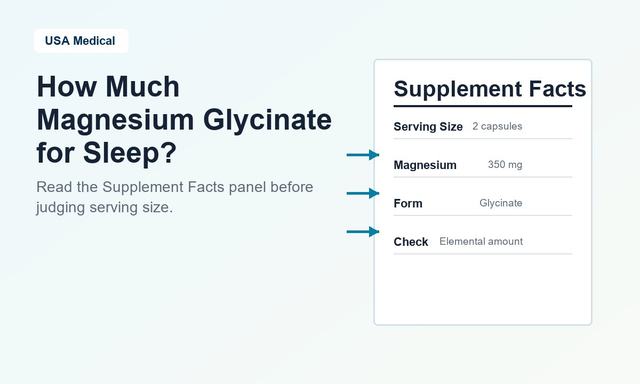
Look for Elemental Magnesium
Elemental magnesium is the actual magnesium amount you get per serving.
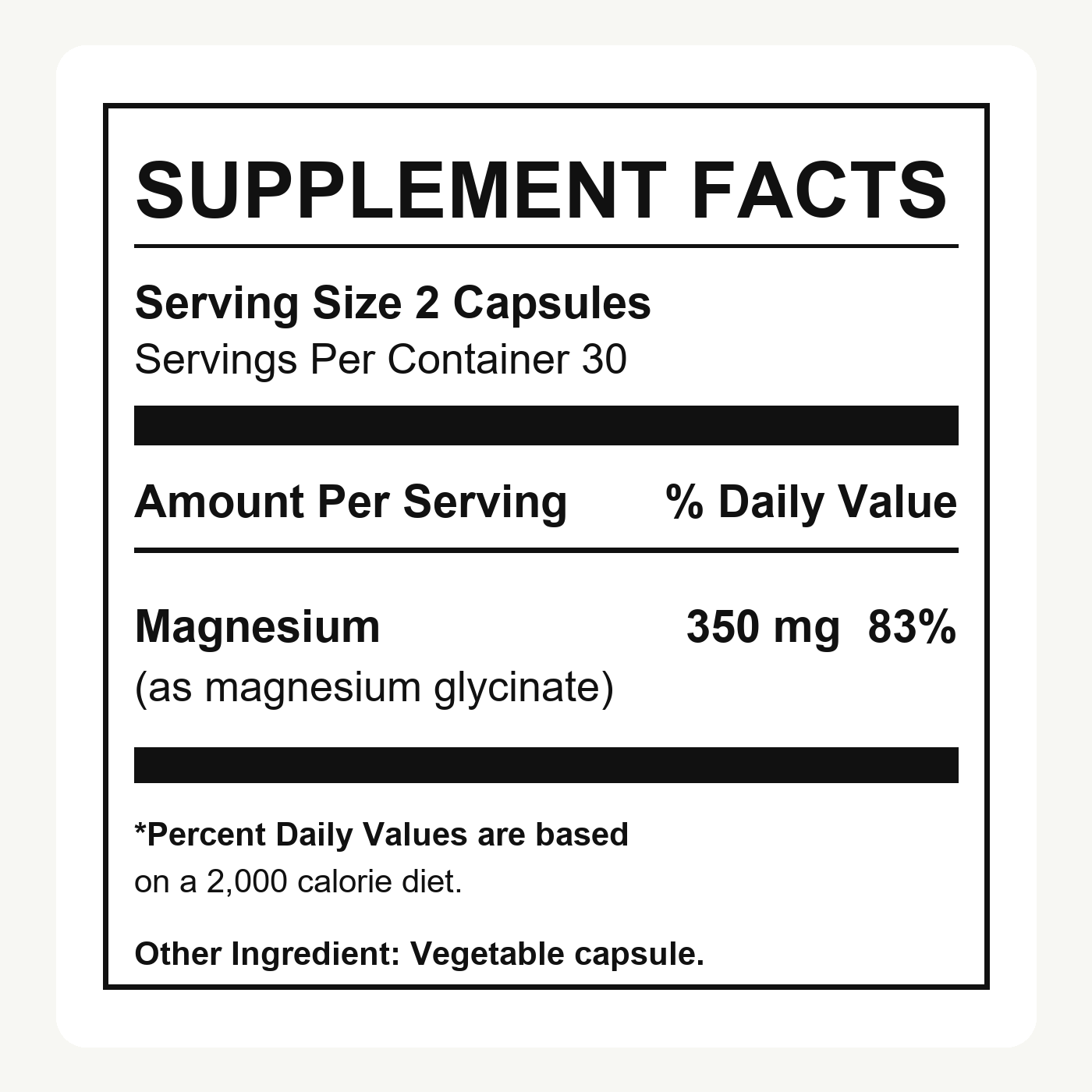
This is one of the most important label details. A product may advertise a large amount of magnesium glycinate compound, but the elemental magnesium amount is what matters for dosage. When comparing two magnesium glycinate supplements, compare the elemental magnesium per serving, not only the front-label claim.
Look for a line that says something like:
"Magnesium 175 mg"
"Magnesium 200 mg"
"Magnesium as magnesium glycinate"
That magnesium number is the key dosage number.
Elemental magnesium tells you how much actual magnesium the serving provides.
Check the Serving Size
Serving size tells you how many capsules, tablets, gummies, or scoops equal one serving.
This is easy to miss. One product may provide 175 mg magnesium in one capsule. Another may provide 200 mg in two capsules. Another may require three gummies or one scoop. If you miss the serving size, you may take more or less magnesium than intended.
Check:
- How many capsules make one serving?
- How much magnesium is in that serving?
- How many servings are in the bottle?
- How often does the label suggest taking it?
- Does the serving fit your routine?
A quality product should make this easy to understand.
Serving size matters because one capsule is not always one full serving.
Avoid Confusing Mega-Dose Marketing
More magnesium is not automatically better.
High-dose magnesium products may look impressive, but too much supplemental magnesium can cause loose stool, diarrhea, nausea, stomach cramping, and other side effects. Adults should also be mindful of the upper limit for magnesium from supplements and medications unless a healthcare professional recommends otherwise.
The best magnesium glycinate supplement is not the one with the most aggressive dose. It is the one with a responsible serving that you can tolerate and use consistently.
A quality magnesium supplement should be effective and responsible, not just high-dose.
Count Other Magnesium Sources
Before choosing a supplement, check whether magnesium is already in your routine.
Magnesium may appear in:
- Multivitamins
- Electrolyte powders
- Greens powders
- Sleep blends
- Mineral complexes
- Antacids
- Laxatives
- Other magnesium supplements
Your body does not care which bottle the magnesium came from. Total supplemental magnesium is what matters.
A quality buying decision includes your total magnesium intake, not just one product.
The Supplement Facts panel tells you the real form, amount, serving size, and safety details behind the marketing.
Look for Quality Standards and Transparency
Because dietary supplements are not approved like drugs before marketing, brand transparency matters.
Understand What FDA Does and Does Not Do
In the United States, dietary supplements are regulated differently from prescription drugs.
The FDA does not approve dietary supplements for safety and effectiveness before they are marketed. That means the responsibility for choosing a trustworthy supplement falls partly on the consumer. This does not mean all supplements are bad. It means quality standards, manufacturing practices, testing, and transparency matter.
A responsible brand should not claim that its supplement is "FDA approved" as if it were a drug. That is a red flag.
A quality magnesium glycinate supplement should not rely on misleading FDA-approved language.
Look for GMP Manufacturing
GMP stands for Good Manufacturing Practices.
Dietary supplement manufacturers are expected to follow current good manufacturing practices designed to help ensure identity, purity, strength, quality, and composition. This matters because a supplement should contain what the label says it contains and should be made under appropriate quality controls.
When reviewing a brand, look for language such as:
- Manufactured in a GMP facility
- Follows cGMP standards
- Quality-controlled manufacturing
- Lot testing
- Clear expiration date
- Traceable batch or lot number
These details do not guarantee the product is perfect, but they are better than vague claims with no quality information.
GMP language is a useful sign that the brand is thinking about manufacturing quality.
Third-Party Testing Is a Strong Plus
Third-party testing means an outside organization or laboratory evaluates the product.
This can help confirm that the supplement contains what the label says and is not contaminated with harmful levels of certain impurities. Common third-party quality names include USP, NSF, and other reputable testing or certification programs.
A third-party certification is especially valuable for athletes, people subject to drug testing, or anyone who wants added quality assurance. NSF Certified for Sport is particularly relevant for competitive athletes because it focuses on substances banned in sport.
Look for:
- USP Verified
- NSF certification
- NSF Certified for Sport
- Informed Choice or similar sports testing
- Clear third-party lab testing
- Certificate of Analysis availability
Third-party testing is one of the strongest quality signals a supplement can offer.
Ask Whether the Brand Provides a COA
A COA is a Certificate of Analysis.
A COA can show testing for identity, potency, heavy metals, microbes, or other quality factors. Not every consumer needs to read one, but a brand that can provide testing documentation is usually more transparent than one that cannot.
A good COA should be:
- Lot-specific
- Recent
- From a credible lab
- Relevant to the product
- Easy to match to the bottle
- Not just a generic marketing document
A brand willing to show quality documentation is usually more trustworthy than one that hides behind vague claims.
Quality standards matter because supplement trust depends on transparency, testing, and responsible manufacturing.
Choose the Right Magnesium Form for Your Goal
Not every magnesium supplement is designed for the same purpose.
Best Magnesium for Sleep: Glycinate
If your main goal is sleep, magnesium glycinate is usually the best form to consider first.
It is gentle, commonly used at night, and fits well into a wind-down routine. It is also less digestion-focused than citrate or oxide, which makes it more practical for bedtime use.
Choose magnesium glycinate if you want:
- Sleep routine support
- Relaxation support
- Muscle comfort
- Gentle daily use
- Nighttime magnesium
- Less digestive disruption
For sleep and relaxation, magnesium glycinate is usually the most practical form.
Magnesium Citrate Is More Digestion-Focused
Magnesium citrate can be useful, but it serves a different purpose.
It is often chosen for magnesium support plus occasional bowel regularity. That may be helpful for some people, but it may not be ideal before bed if it causes loose stool, urgency, or stomach discomfort.
Citrate may be useful for digestion, but glycinate is usually better for sleep-focused routines.
Magnesium Oxide Is Common but Less Sleep-Focused
Magnesium oxide is widely available and often inexpensive.
It may appear in antacid or digestive products and budget magnesium formulas. However, it is usually not the first choice for people who want a gentle supplement for sleep or relaxation.
Magnesium oxide may be common, but common does not automatically mean best for sleep.
Watch Out for Generic Magnesium Blends
A generic magnesium blend may sound good, but it can hide important details.
If a product lists multiple forms without clear amounts, it may be hard to know how much of each form you are getting. If the first ingredient is magnesium oxide and the front says "glycinate blend," you may not be getting the product you thought you were buying.
Ask:
- Does it clearly list magnesium glycinate?
- Does it include magnesium oxide?
- Is it a proprietary blend?
- Does it list elemental magnesium?
- Does it explain the serving size?
- Does it match your goal?
Clear form labeling is better than vague blend marketing.
For sleep, relaxation, and gentle daily use, choose magnesium glycinate over generic or digestion-focused magnesium blends.
Check Clean Label Details
A quality magnesium glycinate supplement should be simple and easy to understand.
Review Other Ingredients
The active ingredient matters most, but other ingredients still matter.
Common capsule ingredients may include cellulose capsules, rice flour, magnesium stearate, silica, or other excipients. These are not automatically bad, but they should be listed clearly. If you have allergies, sensitivities, or dietary restrictions, read carefully.
Check for:
- Artificial colors
- Artificial flavors
- Added sugar
- Unnecessary fillers
- Common allergens
- Gelatin if you avoid animal products
- Sweeteners in gummies or powders
A clean label should make all active and inactive ingredients easy to identify.
Capsules vs Gummies vs Powders
Magnesium glycinate can come in different formats.
Capsules are usually simple, convenient, and easier to dose accurately. Powders can be useful for people who dislike capsules, but taste and measuring accuracy matter. Gummies may be easier to take, but they often include sugar, sweeteners, flavors, and lower magnesium amounts.
Simple guide:
- Capsules: best for clean, consistent dosing
- Powders: useful if you dislike capsules
- Gummies: convenient, but often less ideal for serious dosing
- Liquids: easy to take, but check additives and serving size
Choose the format that keeps dosing clear and the routine easy.
Avoid Unnecessary Blends
Some magnesium products include melatonin, herbs, amino acids, or sleep blends.
That may sound appealing, but it can make the product harder to evaluate. If you want magnesium glycinate, a simple magnesium product is often better than a crowded formula. This is especially true if you are sensitive to supplements or want to know exactly what is helping.
A simpler formula helps you track:
- Sleep quality
- Digestive comfort
- Muscle relaxation
- Side effects
- Dose response
- Long-term consistency
A simple magnesium glycinate supplement is often easier to evaluate than a complicated sleep blend.
A quality magnesium glycinate product should be clean, clearly dosed, and not overloaded with unnecessary ingredients.
Avoid Red Flags When Buying Magnesium Glycinate
Some product claims should make you more cautious.
Red Flag: "FDA Approved" Supplement Claims
Dietary supplements are not approved like prescription drugs before marketing.
If a magnesium supplement says or implies that it is FDA approved in a misleading way, be careful. A product may be made in an FDA-registered facility, but that is not the same as the FDA approving the supplement for safety or effectiveness.
"FDA approved" language can be misleading for dietary supplements.
Red Flag: Cure-All Claims
Magnesium glycinate can support wellness, but it should not claim to cure major conditions.
Be cautious of claims like:
- Cures insomnia
- Cures anxiety
- Reverses disease
- Eliminates pain
- Fixes depression
- Guarantees deep sleep
- Works instantly for everyone
Responsible supplement brands use careful language. Magnesium glycinate may support sleep routines, relaxation, muscle function, and healthy magnesium intake, but it should not be marketed like a drug.
A quality supplement should make responsible structure/function claims, not disease-cure promises.
Red Flag: Unclear Elemental Magnesium
If you cannot tell how much magnesium is in the serving, choose another product.
A quality supplement should clearly show the elemental magnesium amount. If the label only highlights a large compound number and hides the actual magnesium amount, it may be confusing by design.
If the elemental magnesium amount is unclear, the product is not transparent enough.
Red Flag: No Company Information
A trustworthy supplement brand should be reachable.
Look for:
- Company name
- Website
- Contact information
- Lot number
- Expiration date
- Clear return or support process
- Quality or testing information
If a brand has no real presence, no support, and no quality details, that is a problem.
A supplement brand should be transparent enough that you know who made it, what is in it, and how to contact them.
Avoid magnesium products with vague labels, unrealistic claims, and no quality transparency.
How to Choose Magnesium Glycinate for Sleep
If your goal is sleep, choose a product that fits a calm nighttime routine.
Look for Glycinate or Bisglycinate
For sleep, the form should be clear.
Choose magnesium glycinate, magnesium bisglycinate, or chelated magnesium glycinate. These are typically the most relevant forms for sleep and relaxation routines.
For sleep, the magnesium form should clearly be glycinate or bisglycinate.
Choose a Gentle Serving
A quality sleep supplement should not overwhelm your stomach.
If you are new to magnesium glycinate, start low and increase slowly only if the label allows and you tolerate it well. If loose stool, diarrhea, nausea, or cramping appears, scale back.
The best magnesium glycinate serving for sleep is the one you tolerate consistently.
Pair It With a Routine
The product matters, but the routine matters too.
A magnesium glycinate sleep routine might look like:
- Take magnesium glycinate with water.
- Dim the lights.
- Put your phone away.
- Read or stretch.
- Keep the room cool.
- Go to bed at a consistent time.
Do not expect magnesium to cancel out late caffeine, heavy screen use, alcohol, or inconsistent sleep timing.
Magnesium glycinate works best when it supports good sleep habits.
Consider USA Magnesium Glycinate
If you are looking for a simple magnesium option for sleep, relaxation, and nightly support, USA Magnesium Glycinate is designed around the most practical form for that goal: magnesium glycinate.
When choosing any product, including ours, the same rules apply: read the label, check the serving size, understand the elemental magnesium amount, follow the suggested use, and listen to your body.
A quality magnesium glycinate supplement should make your sleep routine simpler, not more complicated.
For sleep, choose a clear glycinate form, a responsible serving, and a routine you can repeat.
Safety Questions Before Buying
A quality choice also means choosing what is safe for your situation.
Who Should Ask a Doctor First?
Ask a healthcare professional before taking magnesium glycinate if you:
- Have kidney disease
- Take prescription medications
- Are pregnant or breastfeeding
- Have heart rhythm concerns
- Use magnesium-containing antacids or laxatives
- Take antibiotics
- Take osteoporosis medications
- Have chronic digestive issues
- Have been told your magnesium is high or low
Magnesium can interact with certain medications and may be risky for people whose kidneys cannot remove excess magnesium properly.
A quality supplement still needs to fit your health situation.
Watch for Side Effects
Even magnesium glycinate can cause side effects.
Possible side effects include:
- Loose stool
- Diarrhea
- Nausea
- Stomach discomfort
- Cramping
These are more likely if you take too much, increase too quickly, or combine magnesium products.
Side effects are a sign to review the dose, timing, and total magnesium intake.
Keep a Supplement List
Write down what you take.
Include vitamins, minerals, powders, gummies, herbs, sleep blends, antacids, and laxatives. This helps you avoid overlap and makes it easier to talk to a doctor or pharmacist.
Your list should include:
- Product name
- Serving size
- Magnesium amount
- Time of day
- Reason for taking it
- Side effects or notes
A supplement list helps you use magnesium glycinate more safely.
The best magnesium glycinate supplement is not just high quality on the shelf. It also has to be appropriate for your body.
Conclusion: Choose Magnesium Glycinate Based on Form, Label, Testing, and Trust
A quality magnesium glycinate supplement should be clear about the magnesium form, elemental magnesium amount, serving size, suggested use, and other ingredients. For sleep and relaxation, magnesium glycinate or magnesium bisglycinate is usually the best form to consider first. Look for transparent labeling, responsible dosage, GMP manufacturing, third-party testing when available, lot numbers, expiration dates, and a brand that does not make exaggerated cure-all claims. Avoid vague magnesium blends, misleading "FDA approved" language, unclear elemental magnesium amounts, and products that do not tell you who made them. The best magnesium glycinate supplement is simple, transparent, gentle, and easy to take consistently.
Comments
Comments are coming soon. For now, send product questions to our support team and we will help you decide whether magnesium glycinate makes sense for your routine.