A COA Is a Traceability Document, Not a Badge
FDA's dietary-supplement CGMP guide defines a supplier Certificate of Analysis as a document that records characteristics and attributes of a component. For certain component specifications, relying on a supplier COA requires supplier qualification, methods, limits, actual results, documentation, reconfirmation, and quality-control review. [1] [2]
Finished-batch verification is a related but separate question. The CGMP rule requires verification of selected product specifications for identity, purity, strength, composition, and contaminant limits using scientifically valid tests or examinations and adequate documentation. [2]
USA Medical Lot 2025285: What the Results Show
Your Lot COA
See the finished-product testing record
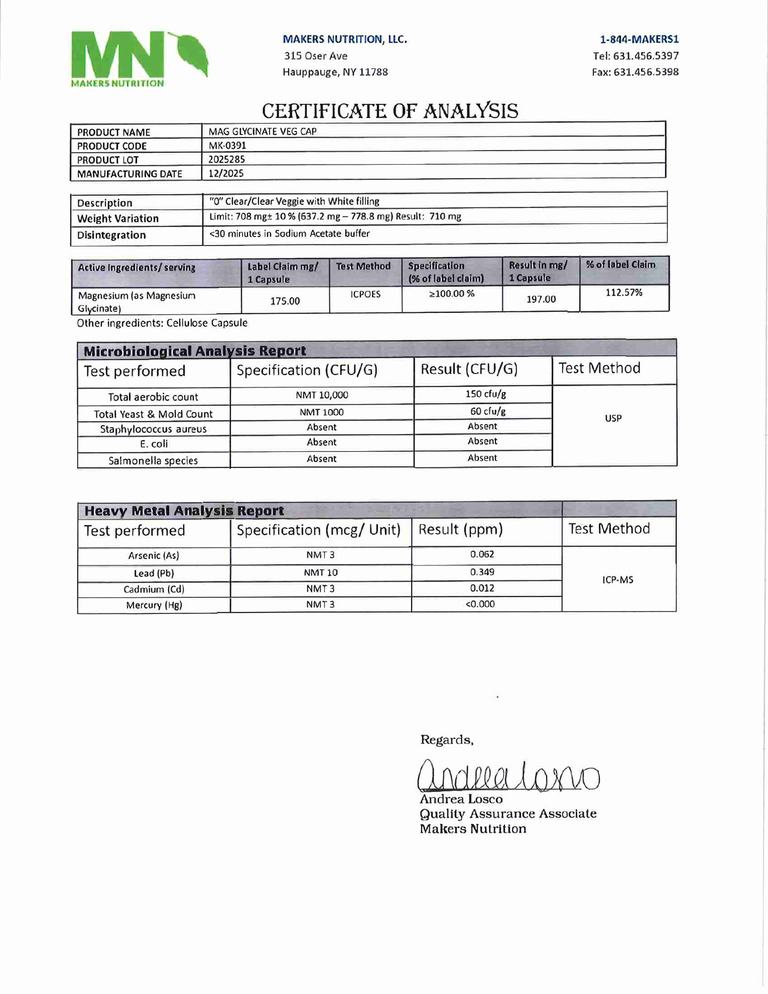
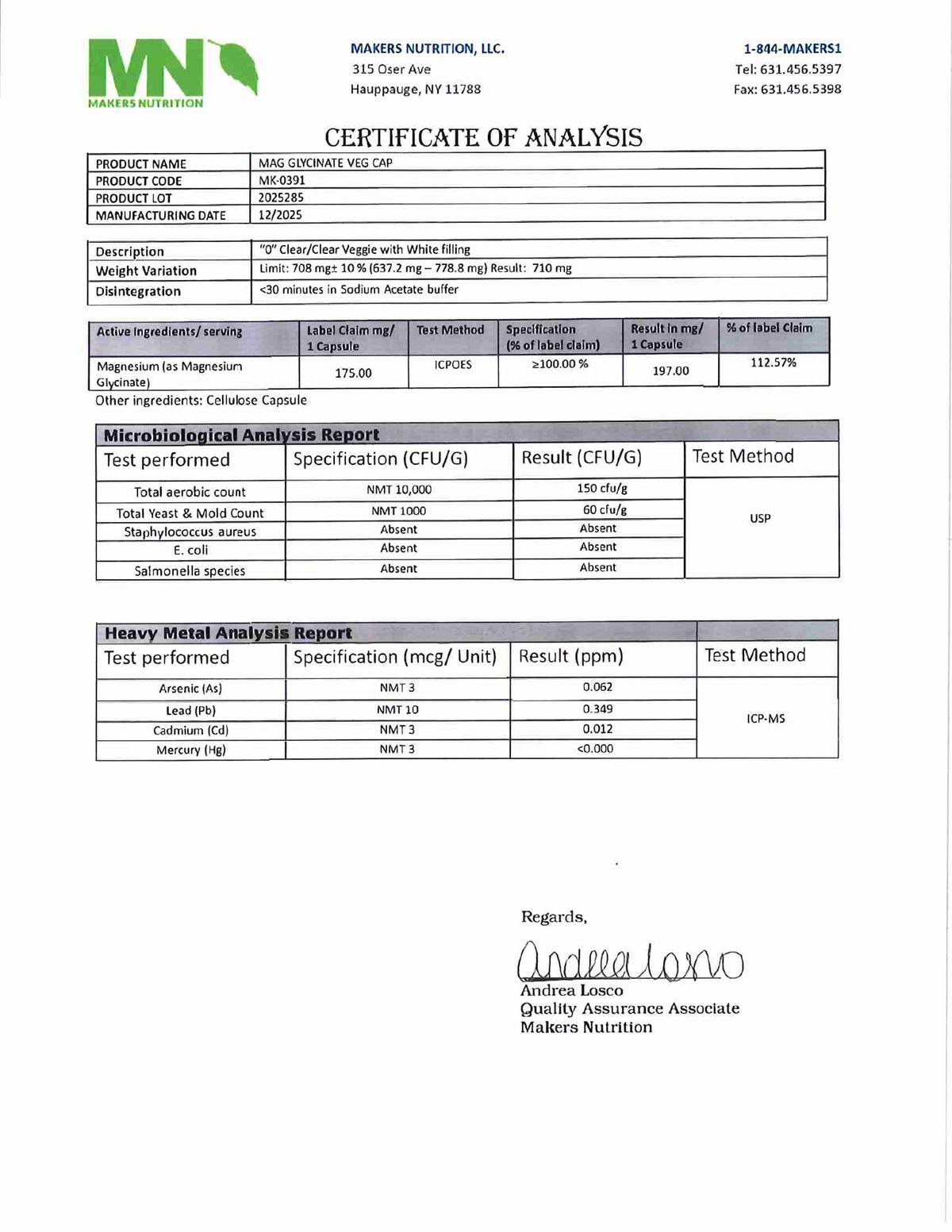
Makers Nutrition issued this finished-product COA for USA Medical Magnesium Glycinate product MK-0391, lot 2025285. The original document is published so you can inspect the specifications, methods, results, and quality approval yourself.
- Potency: 197 mg elemental magnesium per capsule against a 175 mg label amount, marked Pass.
- Heavy metals: arsenic, lead, cadmium, and mercury meet the listed specifications.
- Microbial quality: aerobic count, yeast and mold, E. coli, Salmonella, and S. aureus meet the listed specifications.
- Traceability: the record identifies product MK-0391, lot 2025285, and documented quality approval.
Six Elements Every Useful COA Should Check
A credible COA should do more than display a laboratory name or a row marked 'Pass.' Before treating any certificate as meaningful product evidence, confirm that it answers these six questions.
The six checks work together. A result can look reassuring on its own while still being difficult to interpret if the method, limit, units, dates, approval, or lot connection are missing. [1] [2]
Identity Answers 'What Is It?'; Potency Answers 'How Much?'
| Evidence field | Question it answers | Strong document behavior |
|---|---|---|
| Product or material name | What was submitted? | Matches the specification and report |
| Lot or batch number | Which production unit? | Can be tied to inventory or a bottle lot |
| Identity test | Is the material the claimed ingredient? | Names a suitable method and reports an actual result |
| Elemental assay | How much magnesium was measured? | Shows units, target/specification, and numeric result |
| Composition test | Does the finished product match its formula? | Uses a scientifically valid test or documented verification basis |
An identity pass does not prove the dose, and an elemental-magnesium result does not by itself prove every aspect of chemical identity. Read the rows as separate questions, then confirm that the tested unit and consumer serving use compatible units.
Heavy-Metal and Microbial Rows Need Limits and Actual Results
For lead, arsenic, cadmium, and mercury, look for units such as parts per million, a defined specification or reporting limit, and an actual numeric result or a clear less-than value. A bare 'pass' hides how the result relates to the limit.
Microbial review usually separates total aerobic count, yeast and mold, and specified organisms such as E. coli or Salmonella. Count tests should show units and limits; organism tests should state absence or another defined result. The right panel depends on the ingredient, product, and established risk-based specifications. [1] [2]
Methods, Dates, and Approval Are Part of the Result
- Method: enough information to identify the test or examination used.
- Specification: the acceptance criterion set before interpreting the result.
- Actual result: a number, less-than value, detected/not detected result, or other defined observation.
- Chronology: sampling, manufacture, testing, and release dates that make sense together.
- Approval: evidence that authorized quality personnel reviewed the basis and disposition.
- Lot linkage: a path from the report to the material or finished batch actually offered for sale.
The 60-Second COA Reader Checklist
- Can I identify exactly what material or finished product was tested?
- Is there a lot or batch number I can connect to the product?
- Are method, specification, and actual result visible for each important test?
- Do elemental-magnesium units match the label's serving convention?
- Are heavy-metal and microbial limits explicit rather than implied?
- Do all dates follow a plausible sequence?
- Is quality review or approval documented?
- Does the seller explain any mismatch instead of hiding it?
- Use the magnesium buyer-quality checklist Connect the evidence document back to the label.
- Understand elemental magnesium Reconcile compound, capsule, and serving amounts.
Conclusion
A trustworthy COA is useful because it can be audited, not because it looks official. USA Medical publishes the Makers Nutrition finished-product COA for product MK-0391, lot 2025285 so customers can review its magnesium potency, heavy-metal, and microbial results directly. The claim stays bounded to that document and lot.